
At six in the morning the fish market floor is dry. By eight, the display beds are dripping, the ice has collapsed and a sheet of water is running between the stalls. The floor drain takes the first hour without complaint. Then the water stops moving. A pool forms at the low corner, scales collect around the cover and the smell changes from cold room to low tide.
The complaint is rarely “the drain is blocked.” It is “the drain worked yesterday.” That is the useful clue. A fish market drainage system is not asked to carry clean water. It carries meltwater, blood, fish fat, fins, scales and grit from crates and boots. When solids arrive faster than water can move them, the drain becomes a filter that eventually stops passing water.
This is a different duty from bathroom sanitary ware. A shower drain is sized around soap and hair; a fish market drain is sized around a daily shock load of ice and organic solids. The fixture can look similar. The flow path and the cleaning routine cannot.
The complaint: clear water at the cover, no flow at the outlet
The first inspection finds a cover that looks half clear. Water stands 10–20 mm above it, so the grate appears to work. Lift the cover and the real problem appears: a mat of scales, fins and pale fat has formed in the channel. Scales overlap like roof tiles, and fish fat holds them together. Water passes around the edges for a time, then the mat seals the remaining openings.
At the outlet, the water has lost velocity. A shallow channel with a flat section, a counter-slope or a badly set sump gives solids a place to settle. The pipe mouth may be open. The channel is the blockage; rodding the branch line will not help.
Six reasons a fish market drain falls behind
- The ice arrives as a shock load. A display bed can hold tens of kilograms of ice, and it melts into the drain in a short window.
- Scales bridge the grate. Individual scales are small, but they stack across slots and lock together. A few spanning the opening cut the free area sharply.
- Fish fat and protein form a film. Cold water spreads the fat; warmth later lifts it. The film traps grit and becomes a sticky biofilm that holds odour.
- The grate is chosen for looks, not solids. A wide slot passes scales; a fine mesh stops them but blinds under fat unless it is cleaned. Neither works without a removable tray.
- The channel is too shallow or too flat. A 45 mm channel has little depth once a 15 mm solids layer forms. A fall lost during bedding creates a low section where everything stops.
- There is no solids trap before the pipe. If the only access is the cover, every cleaning operation pushes material toward the outlet.
Separate, convey, then collect
The channel is working sanitary ware, not decorative trim. A reliable layout does three jobs: keep solids at the surface where they can be picked up, move water fast enough to stay self-cleansing, and give fines a sump before the pipe. One fixture rarely does all three well.
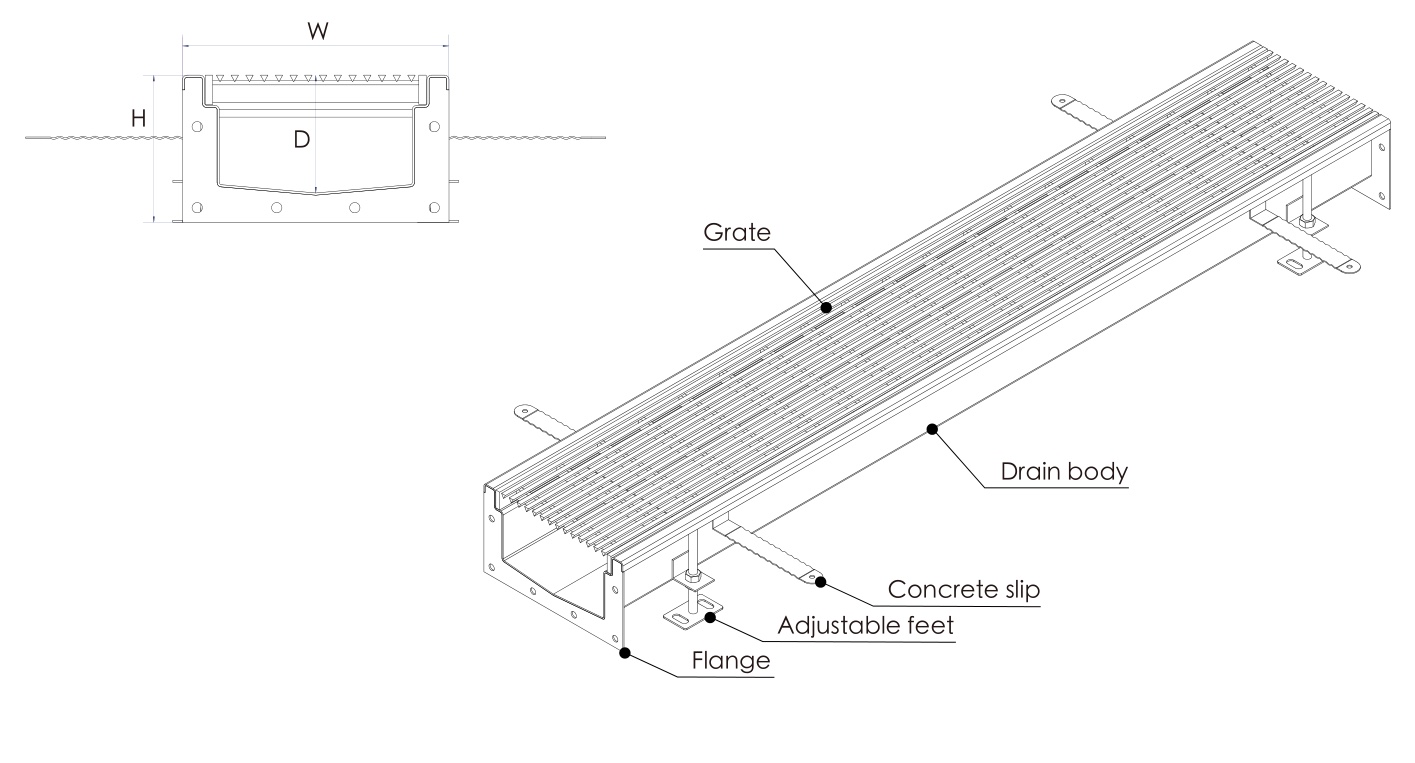
Along a row of stalls, a continuous stainless trench drain is a better fit than a series of point drains. It gives meltwater a short, direct path instead of asking it to cross a wet floor to one low point. A 181 mm wide stainless channel with 80–100 mm depth and 1 m modules can run continuously, with matched corners, branches and end caps. SS304 is standard; SS316 is safer where brine, salt or aggressive sanitation chemicals are used daily.
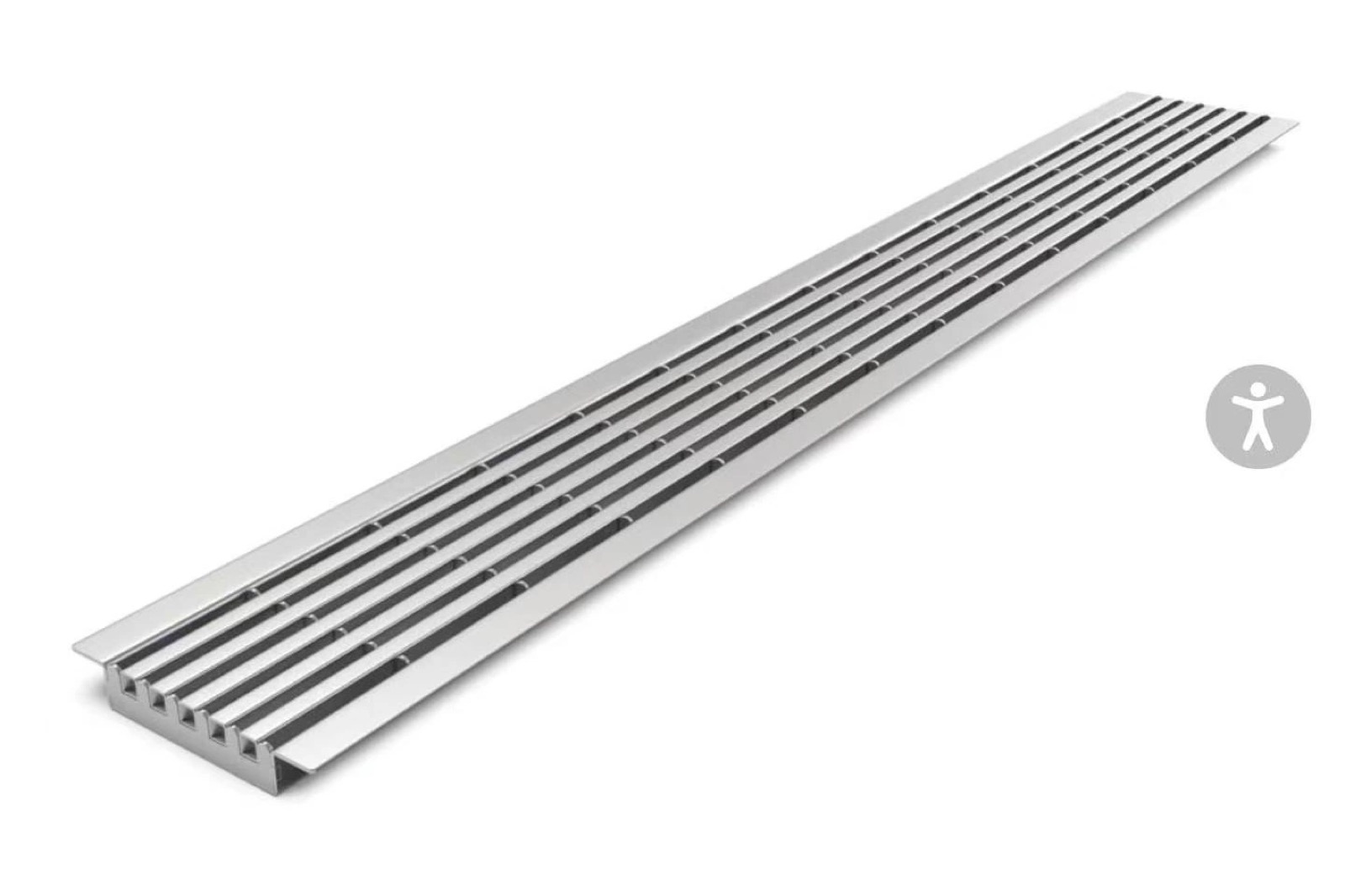
The grating must be removable and stiff. The HW05W wedge wire grate uses a 5×4 mm V-wire profile in SS304/316, made to measure in 100, 200 and 300 mm widths. It presents a flat surface. It is not a basket: scales can pass a 5 mm opening, so the channel needs a removable solids tray or a sump downstream.
At the low point, a high-flow collection drain helps during washdown. The Ø215 mm round stainless floor drain with a vertical outlet and L15 high-flow body is a larger collection point than a 150 mm square waste. It gives the hose a place to discharge without sending a wave down the channel. It still needs a trap and access.
The numbers to set before the concrete
- Channel: 181 mm wide; 80 mm or 100 mm depth, depending on run and solids load.
- Modules: 1,000 / 1,500 / 2,000 mm, with corners, branches, trash box, end cap, outlet and EPDM gasket.
- Fall: 1:100 along the channel, with no counter-slope. Confirm against the floor drainage drawing.
- Grate: 5×4 mm wedge wire, 100/200/300 mm widths, SS304 or SS316, removable.
- Collection point: Ø215 mm round floor drain, vertical outlet, SS304 body, L15 high-flow.
- Load: do not put a pedestrian channel under pallet-truck or vehicle traffic. Match class, frame and cover to the wheel load.
Set the channel to the finished floor, not the screed. A channel 3 mm low holds water at the joint; one set high becomes a trip edge and a blade for squeegees. Fill the bedding and anchor the frame to the slab, not only the tile. A channel that moves under load will crack the finish and open a path under the floor.
Cleaning that removes the load
Start with solids, not the hose. Shovel or vacuum scales and fins out of the channel before adding water. A hose turns a removable pile into a slurry that settles downstream. Lift the grate and basket; clean them away from the channel. Scrape the invert, then wash with warm water and neutral detergent. Avoid repeated strong chlorine on stainless; it can pit the surface.
At the end of each market day, remove surface solids and rinse. Weekly, open the sump and remove the settled layer before it reaches one-third of its depth. Monthly, check the outlet and trap with a torch and confirm the fall runs one way. Record the date, solids depth and any standing section. Repeat standing water points to the drainage system or the bedding, not the cleaning routine.
Certification and the limit of the label
Specify CE EN 1253 for floor drains, CE EN 1433 for drainage channels where applicable, and ISO 9001 manufacturing. WaterMark is relevant where the product is supplied for the Australian market. A certificate confirms testing to a declared standard. It does not prove the channel has the right fall, the grate matches the solids, or the sump is reachable.
Where to start
If a fish market drain backs up, inspect the channel first. Remove the cover, photograph the solids layer, check the fall and find where water slows. Size the run for the ice load, not the hose flow. Browse our stainless trench drain systems, wedge wire grates and high-flow floor drains, or send the stall layout, outlet position and washdown routine. We match a drainage channel and collection point to a wet, organic load that is cleaned every day.