
The six minutes that flood the plant room
Every backwash cycle starts the same way: the valve turns, the pump runs, and several cubic metres of chlorinated water leave the filter and arrive on the plant room floor faster than the floor drain can take it. The water rises around the pump bases, the drainage channel runs full, and someone reaches for the squeegee while the filter is still backwashing. Ten minutes later the floor is clear, the room is damp, and the stainless fittings have a new line of rust at the waterline.
Pool plant rooms are designed for steady leakage, not for a backwash. The drain is sized for condensation and occasional washdown, and then a routine maintenance operation discharges the equivalent of a small tanker in minutes. The complaint is always "the drain can't cope", and the answer is usually "it was never asked to". The plant room is part of the pool's drainage system, not a corner that can be left to a single small gully.
Why plant room drainage fails at backwash
- Flow, not volume, is the problem. A backwash is a high flow for a short time. A drain that passes 1 L/s happily will surcharge at 5 L/s, and the floor becomes the storage tank.
- The discharge point is not directed. The backwash hose is often laid on the floor and left to run wherever the end points. Water arrives at the drain from the wrong direction and bypasses the channel.
- Chlorinated water and 304 stainless. Pool water carries free chlorine and chloramines. 304 will show tea staining and pitting at the waterline; 316 is the grade for the wetted parts.
- A trap that dries between backwashes. A plant room drain can go weeks without water. The seal evaporates, and the room takes on a sewer smell that is blamed on the pool.
- No sump, or an undersized one. Where the plant room is below the sewer, the drain must discharge into a sump and pump. A sump sized for leakage cannot buffer a backwash.
- Grout and sealant that fail under chlorine. The channel stays watertight only if the sealant is compatible; a failed joint lets water under the channel and into the slab.
| Source | Peak behaviour | Drainage response | Material point |
|---|---|---|---|
| Filter backwash | High flow for 4–8 minutes | Channel plus sump buffer, not drain alone | 316 wetted parts |
| Filter rinse | High flow, short duration | Same path, directed to channel | 316, sealed joints |
| Condensate / leakage | Low, continuous | Gully with water seal | 304 acceptable |
| Deck washdown | Medium, intermittent | Channel to plant room, basket upstream | 316 where chlorinated |
| Chemical dosing spill | Low volume, aggressive | Contained and neutralised, not drained | Check chemical compatibility |
Read the table by peak, not by average. The backwash row sets the channel and sump size; the condensate row sets the trap; the chemical row is a spill procedure, not a drainage design. Designing to the average is how the plant room floods every Tuesday.
Sizing with a worked example
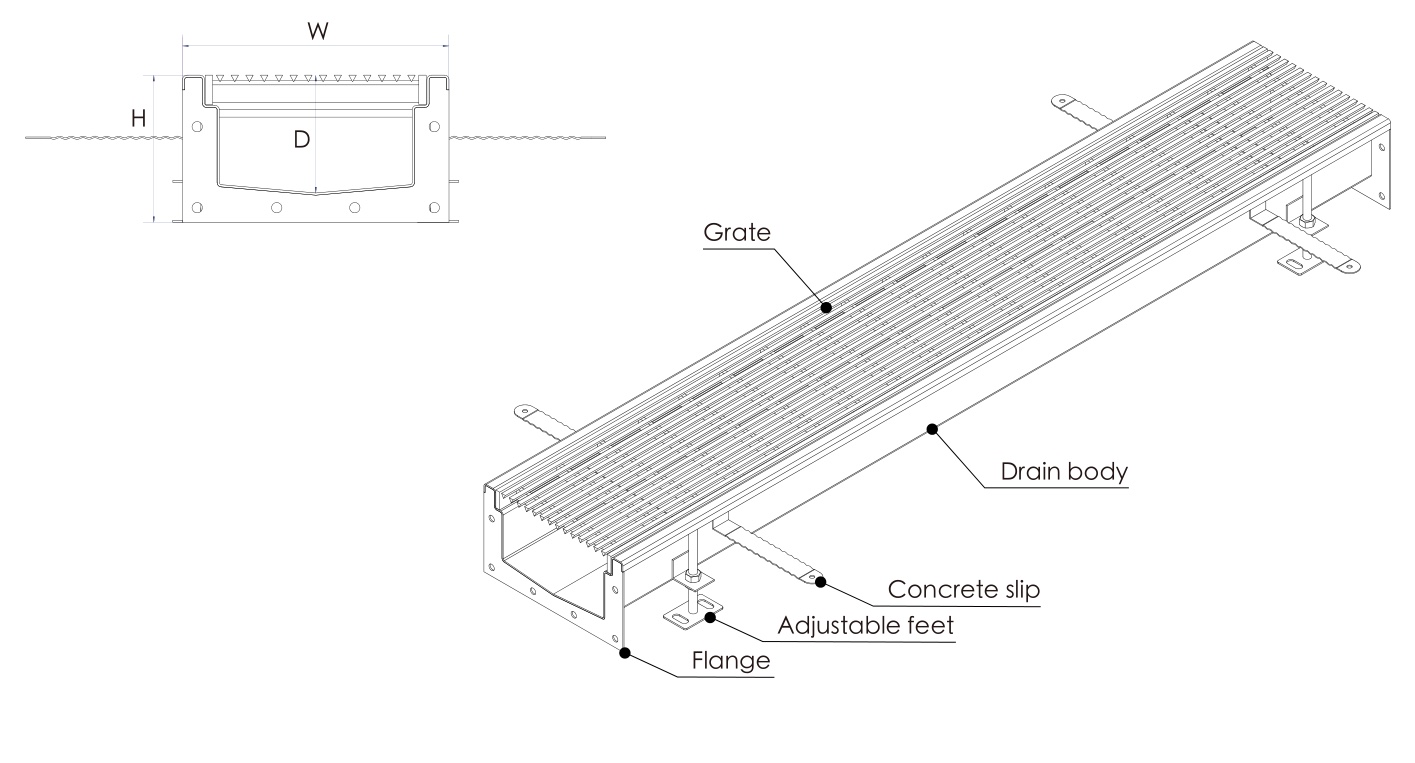
Assume a small sand filter backwashing at 12 m³/h for 6 minutes: 12 × 6 / 60 = 1.2 m³ delivered in 360 seconds, an average of about 3.3 L/s, with a peak at start-up higher than that. A 181 mm wide channel with 100 mm depth running half full has roughly 0.009 m² of flow area; at 0.5 m/s that is about 4.5 L/s, which is marginal before the sump fills. The numbers are an illustration, not a selection: verify the filter's actual backwash flow and duration from its data plate, and add the sump buffer.
The practical answer is a channel plus a sump: the channel collects the discharge across the room, the sump buffers the peak, and the pump empties at a rate the sewer can accept. A pump rated for the backwash peak alone will short-cycle; a sump of one backwash volume with a pump at half the peak flow is the stable combination.
Specification that holds up
- TR80DE stainless channel, 181 × 100 mm, 1 / 1.5 / 2 m lengths, 304 or 316, with corner, branch, trash box, end cap and outlet accessories for a run that turns corners without site fabrication.
- 316 for the wetted path where chlorinated pool water is discharged daily. Specify 316 for the channel, the grate and the fasteners, not only for the visible cover.
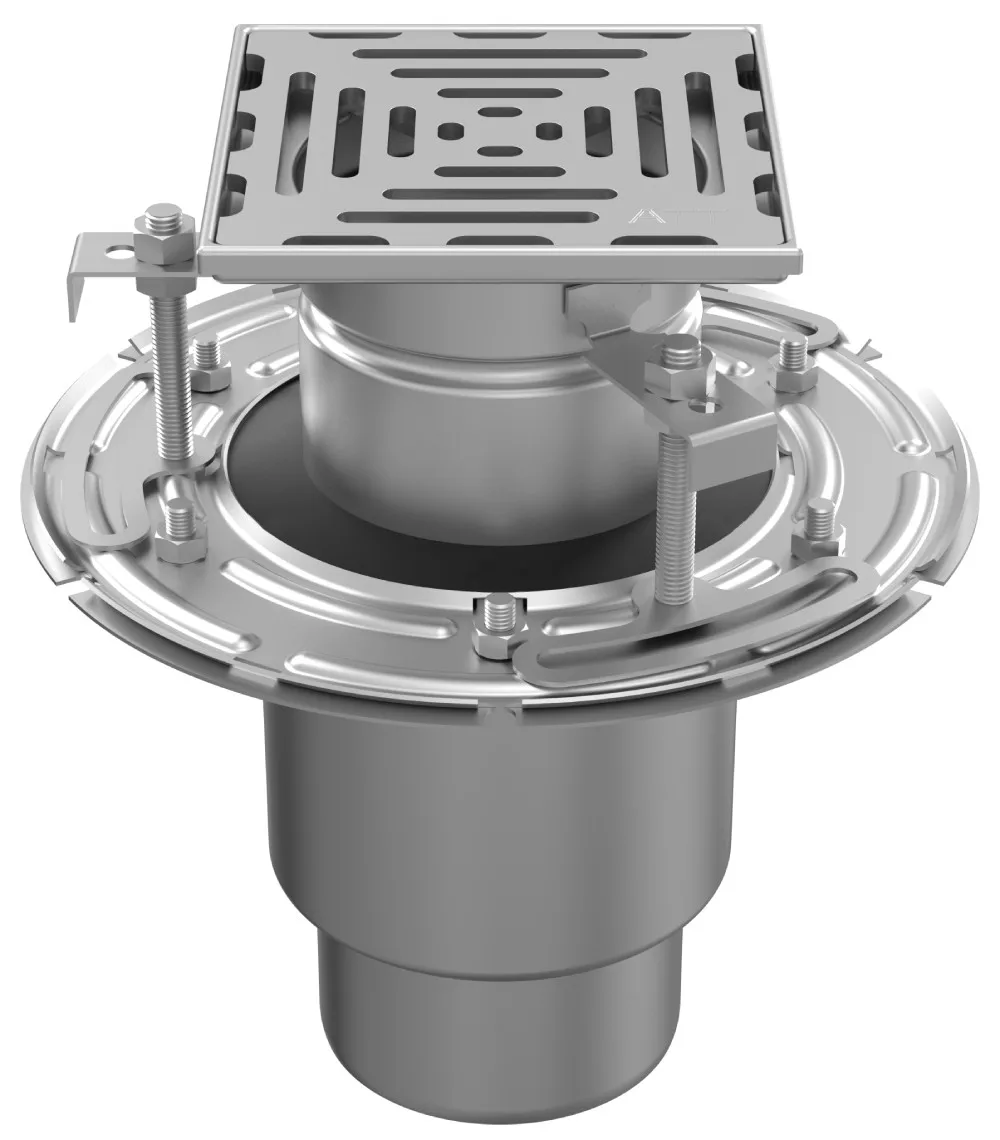
- A high-capacity floor drain with a sealing flange. The industrial floor drain with a vertical outlet and sealing flange is built for processing areas and commercial kitchens: deep outlet for flow, integrated flange for slab integration. In a plant room it handles the routine water while the channel handles the backwash.
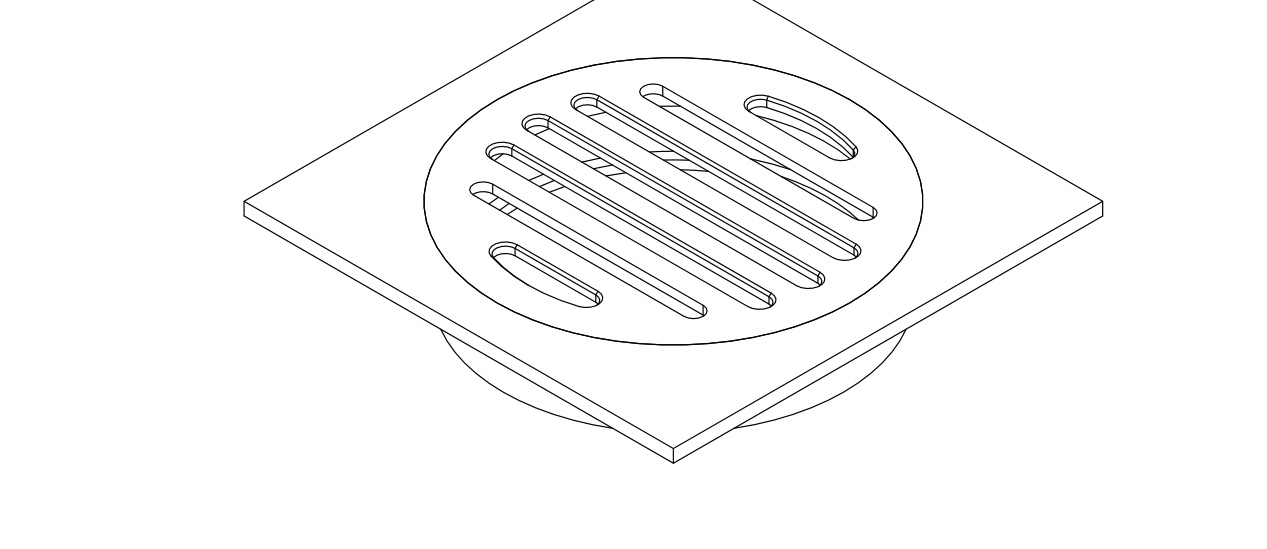
- A stainless cleanout such as CF110, 100 × 100 or 110 × 110 mm, 45/80 or 100 mm outlet, 304/316, light duty, for the low point and the branch line.
- Fall of 1:50 to the drainage channel, with a channel invert that runs to the sump without a flat section. The drainage system has to take both the steady leakage and the backwash peak, which is why the buffer sits between them.
- Utility, not sanitary ware: a plant room trench drain is specified for flow, chemistry and access rather than for a visible finish, and the same discipline applies to the sanitary ware specified for the pool's showers. Sealant and grout rated for chlorinated water and for the movement between a stainless channel and a concrete slab.
Operating procedure on backwash day
- Fix the backwash hose end over the channel, not on the floor. A hose that moves under pressure is the difference between a channel and a flood.
- Start the pump with the sump at low level, and watch the sump level during the cycle rather than the floor.
- If the floor starts to pond, stop the backwash and let the sump catch up; a filter can wait two minutes, a pump room cannot.
- After the cycle, rinse the channel and refill the drain trap. A dry trap is the reason the plant room smells on Monday.
- Check the waterline on the stainless for staining monthly; a new rust line means the grade or the chemical exposure is wrong.
Certification and traceability
Our drainage range is CE EN 1253 certified for floor drains, EN 1433 compliant where a channel is specified to that standard, WaterMark certified on the covered models, and manufactured under ISO 9001. Ask for the certificate that matches the model and the market, and check that the grade and load class on the certificate match what is being supplied — a certificate for a different body size is not evidence for this one.
Next step
Send us the filter backwash flow and duration, the plant room dimensions, the outlet height and whether the room drains by gravity or to a sump. We will size the trench drain and the buffer so the next backwash goes down the drain instead of across the floor.